
Uncategorized
Synthetic Cannabinoid Overdose Response: What Recent Policy Attention Means for K2 and Spice Emergencies
Oct
Important: This article is for safety education, not an endorsement of K2, Spice, synthetic cannabinoid paper, liquid, powder, spray, or any other unregulated intoxicating product. Synthetic cannabinoids can cause unpredictable and life-threatening reactions. If someone may be seriously ill, contact local emergency services immediately.
Recent policy discussions about mental health and substance-use care have placed renewed attention on emergency treatment, public-health coordination, and access to timely support. That attention matters for people who encounter products sold under names such as K2, Spice, herbal incense, synthetic cannabis, or research chemicals.
The central public-health lesson is simple: a product name, package description, or claim such as “extra potent,” “premium,” or “lab created” cannot establish what a product contains or how the body will react. Synthetic cannabinoid formulas may change rapidly, and two packages that look alike may contain different compounds or contaminants.
Why synthetic cannabinoid emergencies are difficult to predict
Synthetic cannabinoids are laboratory-made chemicals that can interact with the same broad biological system affected by cannabis, but they are not simply “stronger cannabis.” Some compounds may activate cannabinoid receptors more intensely or behave differently in the body. Products can also contain mixtures that are not clearly disclosed.
They may appear in plant material, coated or soaked paper, powders, liquids, sprays, or other formats. Terms such as K2 sheets, infused paper, K2 liquid, and herbal blend describe a format or marketing category—not a reliable safety profile.
Risk can be increased by unknown concentration, uneven distribution, accidental exposure, co-use with alcohol or other drugs, underlying heart or mental-health conditions, and delayed medical attention. Because formulas change, previous experience with one product does not predict the effect of another.
Recognizing a possible synthetic cannabinoid emergency
Reactions can range from severe anxiety to loss of consciousness. A person does not need to display every warning sign for an emergency response to be appropriate.
Call emergency services immediately for:
- Unresponsiveness, collapse, or inability to wake the person
- Seizures, repeated convulsions, or severe uncontrolled shaking
- Difficulty breathing, slow or abnormal breathing, choking, or blue or gray lips
- Chest pain, a very fast or irregular heartbeat, or signs of sudden weakness
- Extreme agitation, violent behavior, hallucinations, or severe confusion
- Very high body temperature, heavy sweating, or skin that feels unusually hot
- Repeated vomiting, especially when the person is drowsy or unconscious
- Signs of a serious injury, poisoning, or an unknown mixed-drug exposure
Severe panic, paranoia, or unusual behavior should also be treated seriously. A person who seems frightened may become disoriented, run into traffic, fall, act aggressively, or unknowingly place others at risk.
Synthetic cannabinoid overdose response: practical steps
The safest response is to prioritize emergency assessment rather than trying to identify the exact product at home. Follow the dispatcher’s instructions and stay with the person if it is safe to do so.
1. Check the situation before approaching
Look for immediate hazards such as traffic, fire, broken glass, needles, chemicals, or aggressive behavior. Do not put yourself in danger. If the person is violent or severely agitated, keep a safe distance and tell the dispatcher exactly what is happening.
2. Call for professional help
Tell emergency services that the person may have taken or been exposed to a synthetic cannabinoid or an unknown substance. Share the location, symptoms, approximate timing, and whether the person is breathing normally. Be honest about alcohol, medications, opioids, stimulants, or other substances that may also be involved.
3. Check breathing and responsiveness
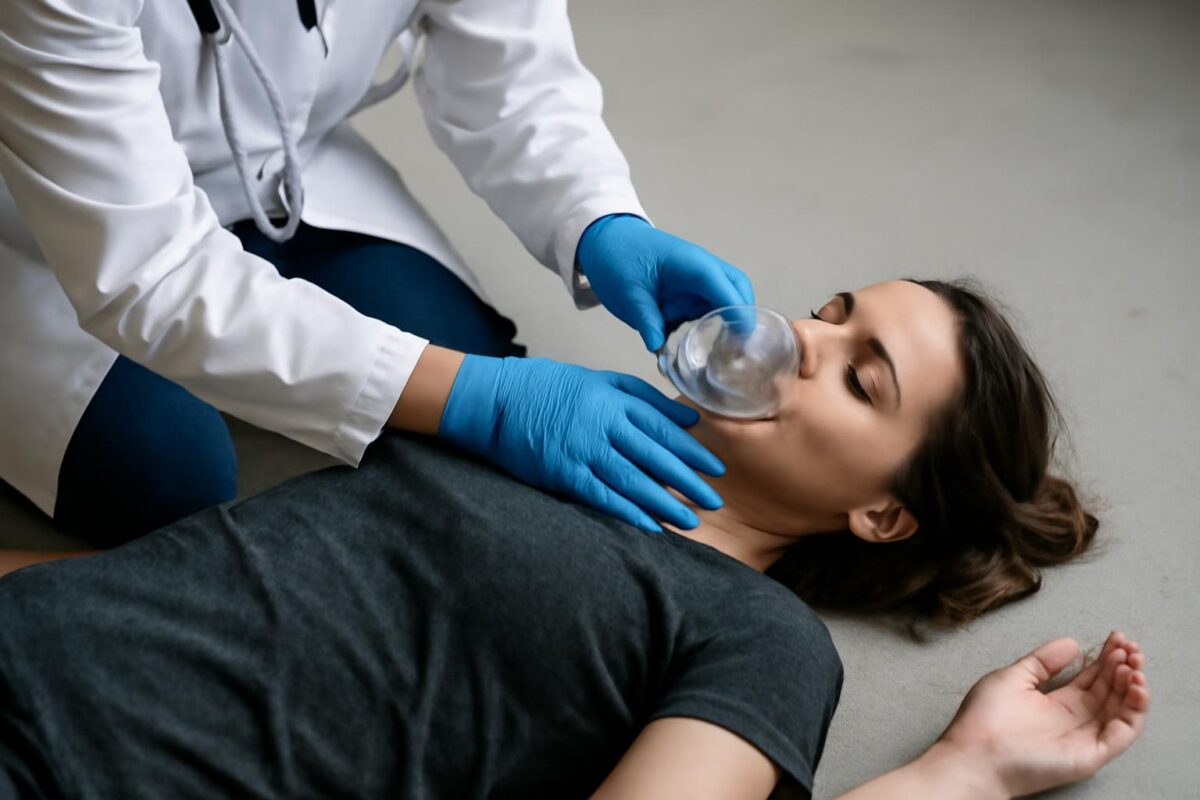
If the person is not breathing normally, follow the dispatcher’s instructions and begin appropriate resuscitation if you are trained. If the person is unconscious but breathing, place them on their side in the recovery position when possible and monitor their breathing continuously.
Do not leave an unconscious person alone, place objects in their mouth during a seizure, or restrain someone who is confused unless immediate safety requires protective action. Move nearby hazards away and keep the surroundings calm.
4. Prevent additional exposure
Do not give the person more substances, food, drink, or medication unless a medical professional tells you to. Do not try to make them vomit. Avoid handling loose powders, liquids, or plant material with bare hands, and keep products away from children and pets.
5. Preserve useful information
If it can be done safely, keep the packaging or take a photograph of the label for clinicians. Do not delay medical care to search for a product name or ingredient list. A label may be inaccurate, incomplete, or unrelated to the actual contents, but it can still provide investigators with a starting point.
Why naloxone may still be relevant—but is not a complete answer
Naloxone reverses opioid effects; it does not reverse the effects of synthetic cannabinoids themselves. However, unregulated products may be used alongside opioids, or an unknown substance may contain an opioid. If opioid exposure is possible and naloxone is available, use it according to local guidance while calling emergency services.
Do not assume that a person is safe because naloxone does not change their symptoms. Continue monitoring breathing and responsiveness, and follow instructions from emergency responders. Synthetic cannabinoid toxicity can involve seizures, cardiovascular complications, severe agitation, or overheating that require medical treatment beyond naloxone.
Why product format does not equal product safety
Searches for terms such as potent K2 paper, K2 spray, synthetic cannabinoid powder, or liquid incense often reflect a format, strength claim, or marketing phrase. None of those terms provides a dependable measure of dose, purity, or risk.
Paper may be described as coated, dipped, soaked, or infused. Liquids may be marketed as concentrates or drops. Herbal products may use familiar botanical language even when their effects come from undisclosed chemicals. A “lab-tested” or “premium” statement is not a substitute for independent, current testing that identifies the actual active compounds and their concentration.
Even when testing is reported, a result from one batch cannot automatically be applied to another. Storage, handling, moisture, and uneven distribution may also affect exposure. For these reasons, people should not rely on package claims to decide whether a product is safe to use, share, transport, or give to someone else.
For general context, readers can review the K2 Sheets Shop home page, but product listings and marketing descriptions should not be treated as medical advice or proof of safety. The site’s category index and product index likewise cannot verify the contents or health risks of any unregulated product.
What clinicians may need to know
When a person reaches an emergency department, useful information includes what was taken, when it was taken, how it was used, how much may be missing, and whether other substances were involved. Tell clinicians about prescribed medicines, pregnancy, heart conditions, seizure history, diabetes, psychiatric diagnoses, and recent injuries.
Do not wait for certainty. Saying “the substance is unknown” is more helpful than guessing. Medical teams may need to monitor breathing, heart rhythm, temperature, neurological status, hydration, and mental status. Routine drug screens may not detect every synthetic cannabinoid, so the clinical history and observed symptoms remain important.
After the immediate crisis
A person who recovers quickly may still need follow-up. Confusion, anxiety, sleep disruption, chest symptoms, recurrent vomiting, weakness, or unusual behavior should be reported to a healthcare professional. An emergency can also reveal a need for support with stress, trauma, depression, dependence, or unsafe living conditions.
Approach the conversation without blame. Ask what happened, whether the person feels safe now, and whether they are worried about using again. Encourage contact with a doctor, addiction specialist, mental-health professional, or local treatment service. If there is an immediate risk of self-harm or harm to others, contact emergency services or a crisis service in the person’s country.
Frequently asked questions
Is K2 the same as cannabis?
No. K2 and Spice are common names associated with synthetic cannabinoids, while cannabis comes from the cannabis plant. Synthetic cannabinoid products can have different and less predictable effects, particularly when the ingredients or concentration are unknown.
Can someone overdose on synthetic cannabinoids?
Yes. Severe poisoning can involve breathing problems, seizures, dangerous agitation, abnormal heart activity, overheating, unconsciousness, or death. Any serious or rapidly worsening symptoms require emergency help.
Should I let someone “sleep it off”?
No, not if the person is difficult to wake, breathing abnormally, vomiting, having a seizure, severely confused, or showing other warning signs. An unconscious or heavily sedated person can choke or stop breathing. Call emergency services and monitor them.
Will a home drug test identify K2?
Many routine tests do not detect every synthetic cannabinoid. A negative result does not prove that exposure did not occur or that the person is medically safe. Symptoms and professional evaluation matter more than an at-home result.
What is the most important first step?
Recognize danger early and call emergency services. Give clear information, protect the person from injury, monitor breathing, and avoid adding substances or attempting unproven home treatments.
The public-health takeaway
Current policy attention to substance-use treatment and emergency response reinforces a practical point: timely, nonjudgmental care saves time and can save lives. K2, Spice, synthetic cannabinoid paper, liquid products, powders, sprays, and herbal incense may be sold under many names, but no name can guarantee predictable chemistry.
If an exposure may be occurring now, stop reading and seek professional help. For everyone else, the most useful preparation is knowing the warning signs, keeping emergency contacts available, sharing accurate information with clinicians, and treating bold potency or purity claims with caution.
